Minimizing Brainrot
I recently came across PewDiePie’s video titled “A Secret that Fixes Your Brain”[1]. It was a very entertaining video, as usual. In this video, he goes over how he fixed YouTube by removing Shorts and recommendations from the algorithm. As a long-time member of the 9-year-old army, I clicked on the video immediately.
But as I was watching it, I realized I was doing almost all of the things he mentioned in his video about getting rid of brainrot. I was spending way too much time on Instagram and Reddit, so a couple of weeks ago I decided that the simplest fix to this problem was to remove as many triggers (anything that makes me want to go back to these platforms) as possible.
My main attention drainers were Instagram, YouTube, and Reddit. After consuming so many reels and useless posts on r/askReddit[2], I was always looking for chances to go back to Instagram or Reddit. These platforms had started to feel like the default way to relax.
In this post, I will go over some of the things I did to get rid of brainrot.
YouTube
YouTube was one of my most-used platforms. In a typical browsing session, you fall straight into the algorithmic rabbit hole. You start with a video about Minecraft speedrunning, then click a sidebar recommendation for Super Mario speedrunning, and a few minutes later you are somehow watching 3Blue1Brown. I fully realize that some of this is on me because I should have noticed when I was getting distracted, but I also blame the algorithm a little because it is extremely good at keeping people like me in that loop. I have not learned how to reprogram my brain yet, so the practical solution was to remove the triggers.
In the early days of YouTube, the home page was mostly videos from your subscriptions or completely random videos, and for the most part, you just searched for the video that you wanted to watch. I realized the triggers for me were the videos that YouTube was recommending. This includes the home page and the sidebar. To get rid of these, I did the following:
-
Disable YouTube watch history on Google’s My Activity[3] page. What this does is prevent the YouTube algorithm from having enough data to recommend videos to you. Your home page will now be empty.
-
Then I installed an extension called ImprovedTube[4] (Chrome, Firefox) to make my subscriptions page the default page. If I type
youtube.comin my browser, it redirects me fromyoutube.comtoyoutube.com/feed/subscriptions. This way I only watch the content that I actually want to watch. It made me think, “Hey, now I am finally consuming the content I subscribed to.” Before this, I rarely watched my subscriptions. I also realized how many useless channels I was still subscribed to. I spent a few minutes cleaning them up, and that already felt good. -
The same extension also allowed me to get rid of the sidebar and automatically enable cinema mode, so the video takes up most of the screen space, which is how it should be. There are also options to hide the comment section if you think comments are also a distraction, but I kept them. The extension is so customizable that you can basically cherry-pick the features you want from YouTube and disable everything else.
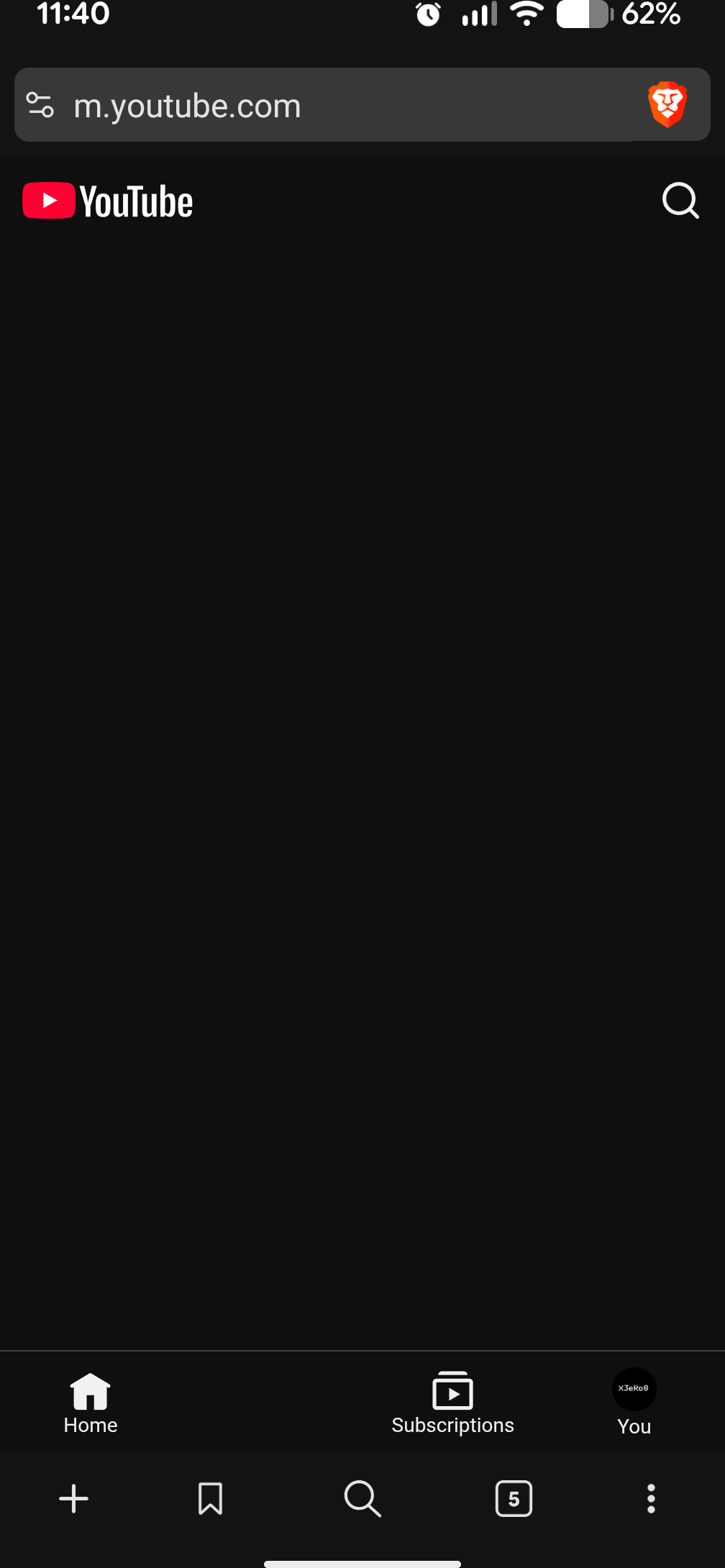
YouTube.com after enabling Brave’s distraction-blocking features.
-
One of the features I got rid of was Shorts. I never want to watch a short again, and I don’t have to explain to you why Shorts are not good. Shorts are the brainrot. Now there are no Shorts in my search results, sidebar, subscriptions, or home page. THEY ARE GONE! There is also an option to redirect YouTube Shorts to regular videos by using the
/watch?v=URL with the same video ID. This lets me view a short if someone sends me one, but the scrolling view is no longer there, so I cannot scroll even if I wanted to. -
Lastly, I uninstalled the YouTube app from my phone and now strictly use the Brave browser for watching YouTube on my phone. Brave browser has a few very useful built-in functions to get rid of these pesky, annoying distractions as well. In Brave, go to
Settings > Media, then enable:Open YouTube links in BraveBlock YouTube recommended contentBlock YouTube Shorts- Optionally
Block YouTube distracting elementsI keep this one disabled because it also removes comments.
My Reddit usage was not as bad as my YouTube usage, so I did not take any drastic steps to ban it completely. I just added Reddit to my DNS blocklist so I could not casually open it on any of my devices. I also uninstalled the app from my phone. Sometimes I still bypass the blocklist to open Reddit posts from Google Search.
Instagram is easily one of the worst platforms for me personally. YouTube, even with all of its distracting elements and soul-sucking algorithm, was still useful because there are plenty of videos, streams, and talks there that help me stay up to date with cybersecurity. Tutorials and lectures were a gold mine for a self-learner like me. But Instagram, in its current state, feels almost completely useless to me. It mostly exists to serve brainrot. TikTok is probably in the same category, but I will not say much about it because I have never used it.
The reason I signed up for Instagram in 2018 was to interact with my friends and their posts, either by chatting with them or by engaging with what they shared. But by 2026, that had basically disappeared. The chat feature is now mostly used to forward Instagram reels, and meaningful conversations there are so rare that I can basically ignore them. That was true for me, at least; I cannot speak for everyone else.
“Everything [brainrot] I say in this video is okay to indulge with. But the key is intent. That’s what matters. Intent matters”
— PewDiePie
I absolutely agree with this. When Instagram shifted from a platform that encouraged people to interact with each other to what it is today, were you consciously choosing that version of it, or were you slowly pushed into it?
The home page on Instagram was supposed to be for seeing posts from people you follow. You still see those posts, but they are very rare. Posts from followers are now buried between posts from people you don’t even follow. Following someone doesn’t mean you actually follow their posts; it just means you can now send each other reels and occasionally interact with their posts. Unlike YouTube, Instagram doesn’t have a followers-only feed where you only see posts from people you follow.
Maybe this is the new, modern way of socialising, where fewer people are actually interacting with their social circle. Ironic, isn’t it?
Similar to YouTube’s algorithm, Instagram is designed to keep you inside the app for as long as possible. The more you use it, the more money they make from advertisements. The more time you spend on the platform, the more data they collect about your interests, behaviour, triggers, and the kind of content that keeps you engaged versus the kind you scroll past.
At first I thought this algorithm was amazing because it kept finding the funniest memes for me. It really did understand my humour. But the same system can learn a lot more about you than just your taste in memes. These companies can build a fairly detailed profile of your habits, interests, likely relationships, and how persuadable you are. If you spend a bit of time reading about the kind of profiles they can build just by observing how you use the platform, it gets unsettling very quickly.
Here are a few articles:
- ICO: Microtargeting[5]
- FTC staff report on large social media and video streaming companies[6]
- Why Metadata Matters[7]
Out of all the platforms I decided to quit, this one was the hardest to leave. Every now and then, a bunch of small triggers would pull me back to it.
I deactivated my account several times, and in the process I noticed the little tricks they use to discourage you from doing it. When you deactivate your account, there is a button that is set by default to “Reactivate my account in 7 days” instead of “Reactivate my account when I want to.” If you do not pay attention, your account gets reactivated again without you noticing.
On top of that, they have added a seven-day deactivation limit, so once your account gets reactivated without you noticing, you cannot deactivate it again for the next seven days. This feels like a made-up restriction that serves no real purpose other than keeping people on the platform.
People have also reported cases where their account was automatically reactivated within a few minutes of being deactivated Reddit discussion[8].
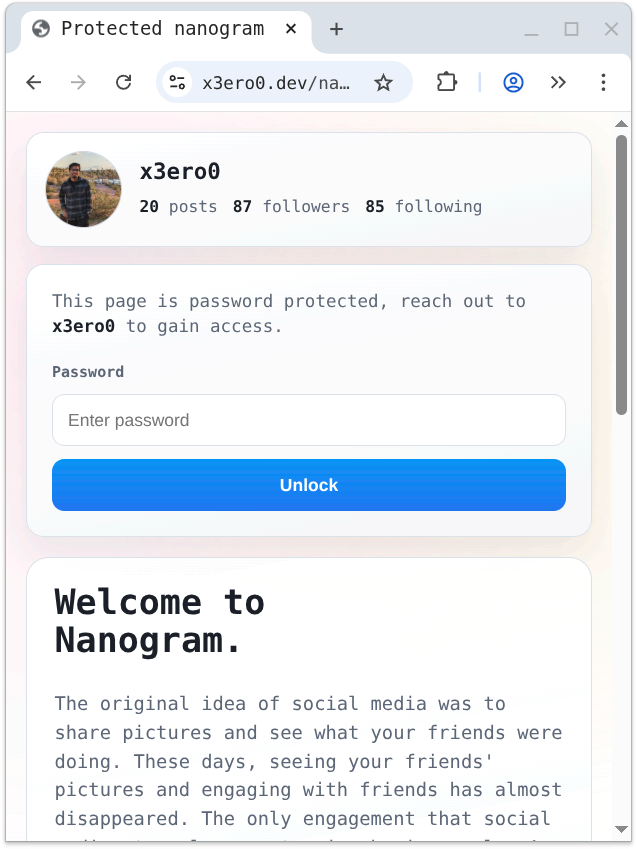
My nanogram home page
Before deleting my account, I requested a high-quality JSON export of my data, and I decided to build something for myself so I could still keep my chosen pictures online without using Instagram. That was the whole reason I had Instagram in the first place. I ended up making nanogram[9], which is a static site that hosts your pictures and videos in the same layout as Instagram. I have my instance of nanogram protected by a password that only I know. If a friend or family member wants to see the pictures I share, they still can, but nobody else can. That was exactly what I wanted.
Nanogram has a few scripts that can parse the JSON export and rehost only the photos and videos from it. Anyone can rehost their Instagram profile with nanogram; all you need is your Instagram data. I am planning to add a feature that lets you upload new pictures and videos without relying on an export. Nanogram also supports comments through Google Forms.
Self-Hosting
If you don’t know what self-hosting is, then here is a very basic definition for you.
Self-hosting basically means running or hosting the services you use on your own hardware and resources. For example, you can host your own password manager instead of using and paying for something like LastPass or ProtonPass. The software will run on your hardware and you are responsible for maintaining it and keeping it up-to-date.
There are lots of reasons to self-host a service, such as control, privacy, ownership, and the peace of mind that comes after the few weeks of initial setup that go into self-hosting. When I disabled YouTube watch history, I also moved away from YouTube Music. I was looking for an open-source platform to host my music and maybe all my other media, and that’s how I found Jellyfin[10].
You can easily get an instance of Jellyfin up and running in a few minutes with Docker Compose[11]. Here is my personal Docker Compose file for running Jellyfin.
services:
  jellyfin:
    image: lscr.io/linuxserver/jellyfin:latest
    container_name: jellyfin
    env_file:
      .env
    volumes:
      - ./library:/config
      - ./media/tvshows:/data/tvshows
      - ./media/movies:/data/movies
      - ./media/audio/music/:/data/music
      - ./media/videos:/data/videos
    ports:
      - 8096:8096
    restart: unless-stopped
All you have to do is save this in docker-compose.yml and run docker-compose up -d in
the same directory and, BOOM! that’s it.
you can access your local instance of Jellyfin at http://localhost:8096/web/index.html#/wizard/start
to set up Jellyfin for the first time. More information about installation via containers can be found here.
Another piece of software I higly recommend you to host yourself is your own network-wide ad blocker. I use Pi-hole[12] for this. Not only does it help block ads on your local area network, but you can also use it as a DNS server and create custom local domains for your home server and other devices.
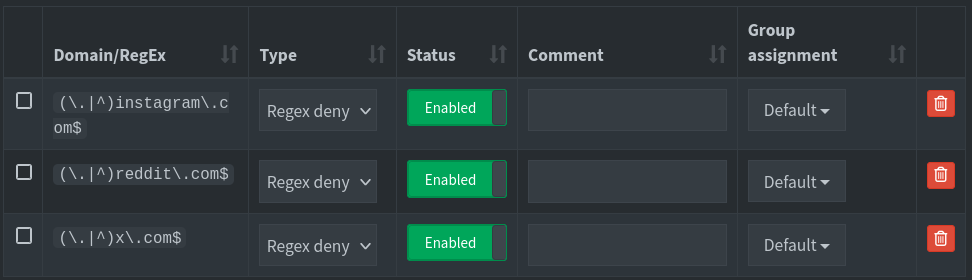
You can install custom blocklists[13] and just say bye-bye to ads and other annoying things on the internet forever. In fact, I use Pi-hole to ban Instagram, Reddit, and X on my local area network.
That is pretty much it. This is how I made the internet fit me instead of letting it shape my habits. Anyway, what is your favorite kind of brainrot? Personally, my favorite is the Italian brainrot. Tung tung tung tung sahur vs Tralalero Tralala was peak!!!
Your comment is under review. Thanks!